
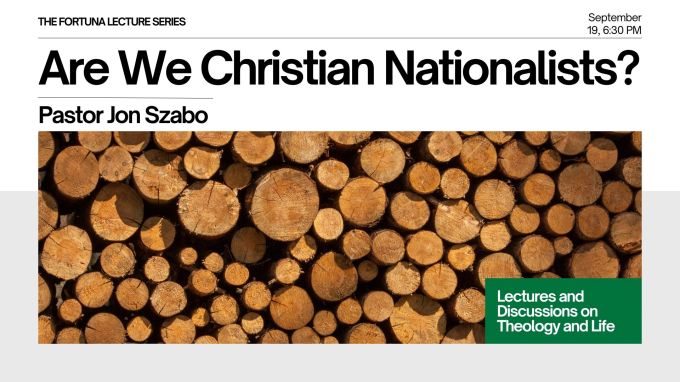
September 19, 2025 – Jon Szabo
2025 FBC Lecture Series – Are We Christian Nationalists?
Pastor Jon Szabo
When you hear the term Christian nationalism, what images come to mind? No doubt
those two words can evoke a wide array of responses. To the progressive democrat
Christian nationalism is a social contagion which promotes violence and racism under
the religious symbol of the Cross. This group will quickly point to the lynch mobs of the
Bible Belt and connect them to the January 6th takeover of our nation’s capital when
Donald Trump was losing power.1
On the other side, to many God-fearing believers, Christian nationalism is the ultimate
pushback to the sexual “transitioning of our kids” –the real present-day contagion. The
social antidote to this social disease is to have everyone repent and return to the faith of
our nation’s forefathers. This group can easily see our nation crumbling like Rome in
self-destruction if it continues to deny the self-evident truths of the Bible.
As you can tell, both sides can get lost in fearmongering and I want to avoid that. Thus,
the purpose of this lecture is to have our emotions and affections shaped by sound
doctrine and not the other way around. The plenary, cogent arguments of Christ in the
Bible are not to play second fiddle to any new terms coming our way, be they red or
blue or somewhere in between.3
So let’s ask the question straight up, “What would Jesus say to the concept of Christian
nationalism?” After reading up on the subject matter and immersing myself in the
Scriptures here is what I see God’s Word in the Spirit of Christ saying.
First, Christian nationalism is more of a God thing than a man thing. Let’s put
things in proper perspective. The New Testament does not at all call Christians to arms
so that we can start big Crusades, conquering nations –that is a God thing. More
precisely, it is a Christ thing. Make no doubt about it. Jesus Christ himself will, in the end
-when all the dust has settled- decide which nations are truly his.4 Listen to what our
Savior says in Matthew 25:31-32. “When the Son of Man comes in his glory, and all the
angels with him, then he will sit on his glorious throne. Before him will be gathered all
the nations, and he will separate people one from another as a shepherd separates the
sheep from the goats.” In this final judgment of world powers, the allies to Christ’s
kingdom will be separated out from the adversarial nations who oppose the Son of Man.
This geopolitical divide comes up later on in the book of Revelation.
In Revelation chapter 21, verses 22 through 26, John writes, “And I saw no temple in
the city, for its temple is the Lord God the Almighty and the Lamb. And the city has no
need of sun or moon to shine on it, for the glory of God gives it light, and its lamp is the
Lamb. By its light will the nations walk, and the kings of the earth will bring their glory
into it, and its gates will never be shut by day—and there will be no night there. They will
bring into it the glory and the honor of the nations.” Who are these surviving kings who
are able to enter into heaven? We can gather from Revelation 18 that they are the ones
who have not joined with so many “kings of the earth” who have themselves fornicated
with Babylon –the pagan empire of the last days.
Second, Christian nationalism will succeed more by the pen than by the sword.
Earlier I pointed out that the New Testament does not call Christians to arms. And that is
true. But this does not mean we avoid confrontation. Quite to the contrary. Listen to
what Paul says in 2 Corinthians 10:4-5, “For the weapons of our warfare are not of the
flesh but have divine power to destroy strongholds. We destroy arguments and every
lofty opinion raised against the knowledge of God, and take every thought captive to
obey Christ…” Paul lives this out in the book of Acts when he takes on a wide array of
debaters coming at him from every angle. Later the apostle Peter sets some parameters
on Christian conduct when getting into those heated confrontations. Read more on that
in First Peter chapter two. So we know it’s not just apostles who are to enter the ring.
I have a question for you. Why not arms? Why not a crusade? Wars may be bloody but
they sure do expand borders. War is efficient. And if you’re concerned about casualties,
could not the Lord himself give us superpowers to win without them? He could. But then
again, Christ is not a typical warrior king. He wins by truth. Listen to Christ speaking
before Pilate in John 18:36 and 37. Jesus answered, “My kingdom is not of this world. If
my kingdom were of this world, my servants would have been fighting, that I might not
be delivered over to the Jews. But my kingdom is not from the world.” Then Pilate said
to him, “So you are a king?” Jesus answered, “You say that I am a king. For this
purpose I was born and for this purpose I have come into the world—to bear witness to
the truth. Everyone who is of the truth listens to my voice.”
If you want to make real inroads to Christian nationalism, hone in on your skills to make
logical Christ-arguments from Scripture. Practice writing, practice speaking. Learn when
and where and how to strike. Right now, the dark forces in our country are busy erasing
any visage of Christianity from our institutions.
5 We are in a strategic position to put
their anti-Christian bias on public display. I don’t want to be overly simplistic but, we
basically have two camps in America. It’s not Republican versus Democrat, it is
Christianity versus practical atheism. And the latter is already showing their true colors.
Third, any promotion of Christian nationalism should be sensitive to our brothers
and sisters overseas who are persecuted for the slightest opposition to a
Communist or Islamic official. Isolationism is a common bedfellow to Christian
nationalism. Here is a right-wing sentiment: You see a nation on the map that rejects
Christianity? Let them sit in their own filth. Let them suffer by their own self-inflicted
wounds. Darwin was right. Survival is of the fittest and if you do not have Christian
values, you simply will not survive. So there. But what about the pockets of light in those
darkened lands? What about the stories of our extended church family we have not yet
heard? By the great commission of Christ we cannot cultivate a silo mentality apart from
these dear souls.
Far from being isolationists we should, in fact, advance our forces into enemy territory
both prayerfully and strategically. A good testing ground for this would be if the strong
churches in America sent their staff pastors across state lines to struggling churches.
This would be a good start. The back-and-forth lessons we learn between our two
coastlines will help us when we cross the Pacific. May a better version of manifest
destiny keep on moving west.
To the title of this essay, “Are We Christian Nationalists?” my answer is, “we have no
reason not to be.” But since this controversial term has not been shaken through the
sieve of church history, you can expect it be derailed by various fringe groups declaring
themselves to be Christian when in fact they are not. Thus we do well to advance the
general cause of Christian nationalism, but only between the guardrails of biblical sound
doctrine.


 Musica Theologica